
Md. Nazmul Islam Sarkar, Anwarul Islam Sifat, Sourav Paul, Md. Shahadat Hossain, Mushfiqur Rahman,
Institute of Energy, University of Dhaka, Dhaka-1000, Bangladesh.
North South University, Dhaka-1229, Bangladesh
Email: sarkarmni@gmail.com

Md. Nazmul Islam Sarkar, Anwarul Islam Sifat, Sourav Paul, Md. Shahadat Hossain, Mushfiqur Rahman,
Institute of Energy, University of Dhaka, Dhaka-1000, Bangladesh.
North South University, Dhaka-1229, Bangladesh
Email: sarkarmni@gmail.com
Md. Milon Uddin*, Mushfiqur Rahman, Md. Tanzid Ridwan Hossain and Md. Habibur Rahman Institute of Energy, University of Dhaka, Dhaka-1000, Bangladesh
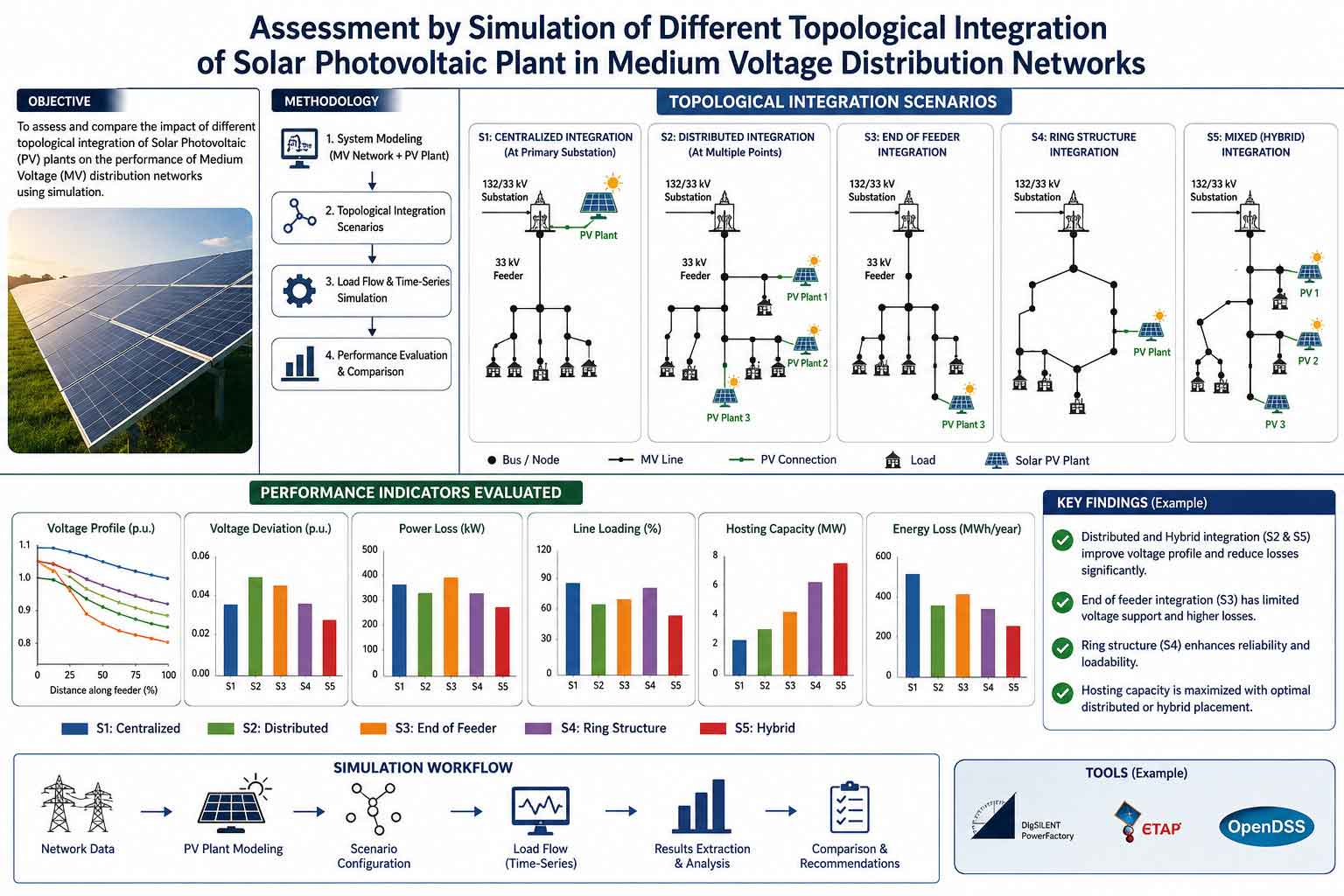
As the world shifts toward cleaner energy sources, integrating solar photovoltaic (PV) systems into existing electricity networks has become a key priority. However, where and how these solar plants are connected to the grid can significantly impact system performance and stability.
A recent study by researchers from the Institute of Energy, University of Dhaka explored how different topological configurations of solar PV plants affect the loadability and stability of medium-voltage distribution networks using the IEEE 14-bus power system model. The research employed Power System Analysis Toolbox (PSAT) simulations to evaluate various PV placement and sizing scenarios.
The findings revealed that the location of a solar PV plant plays a crucial role in improving grid performance. Installing the same-sized PV system at different buses resulted in varying levels of loadability, with some locations significantly enhancing system capacity while others reduced performance. The study also demonstrated that dividing the total PV generation into multiple smaller plants—a concept known as fractioning—can improve grid stability when implemented strategically.
Another important outcome was that the maximum amount of solar power the grid can accommodate depends on the connection point. Buses closer to the slack bus were capable of integrating higher levels of PV generation without compromising system stability. Additionally, simulations involving induction motors showed that appropriate PV placement and distributed generation can further enhance network reliability.
The study highlights that successful renewable energy integration is not only about increasing solar capacity but also about selecting the right locations and network configurations. These insights can support utility operators, power system planners, and policymakers in developing more resilient and efficient electricity distribution networks. As Bangladesh continues expanding its renewable energy portfolio, research-driven approaches like this will play a vital role in ensuring that solar energy strengthens the grid while supporting a cleaner and more sustainable energy future.

Md. Mahfuzur Rahman, Sourav Barua, and Mushfiqur Rahman
Reliable electricity remains a challenge for many rural communities in Bangladesh, where extending the national grid is often difficult and expensive. A research study titled “Hybrid Distributed Renewable Power (HDRP) Generation for Rural Area: Bangladesh Perspective” explores how a combination of solar energy and biomass can provide a practical, sustainable, and cost-effective solution for off-grid villages.
The study highlights Bangladesh’s strong renewable energy potential, particularly in solar and biomass resources. With an average daily solar radiation of 4–6.5 kWh/m² and abundant agricultural waste suitable for biomass energy, the country is well-positioned to adopt hybrid renewable energy systems that can supply electricity to remote communities.
Using the HOMER (Hybrid Optimization Model for Electric Renewables) software, researchers designed and analyzed off-grid hybrid systems for two representative villages. The optimized systems combined photovoltaic (PV) panels, biomass generators, batteries, and inverters to meet local electricity demand while minimizing overall lifecycle costs. Simulation results showed that solar PV and biomass complement each other effectively, ensuring a more reliable power supply than relying on a single renewable source.
The research also found that the hybrid systems could generate electricity at a competitive cost compared to furnace oil-based power plants, while offering significant environmental benefits through reduced greenhouse gas emissions and the use of locally available renewable resources. Although these systems may not replace large-scale conventional power generation, they can play a vital role in electrifying remote areas where grid connectivity remains limited. As Bangladesh continues its transition toward a cleaner and more resilient energy future, hybrid renewable energy systems represent a promising pathway for improving rural livelihoods, enhancing energy security, and supporting sustainable development. Research-driven solutions like HDRP demonstrate that decentralized renewable energy can be a powerful tool in achieving universal access to electricity.